Statement leading to lead magnet.
GLRE explains what an emergency glazing make-safe involves, when it is needed, and how quickly rope access teams can respond. Call us for urgent attendance.

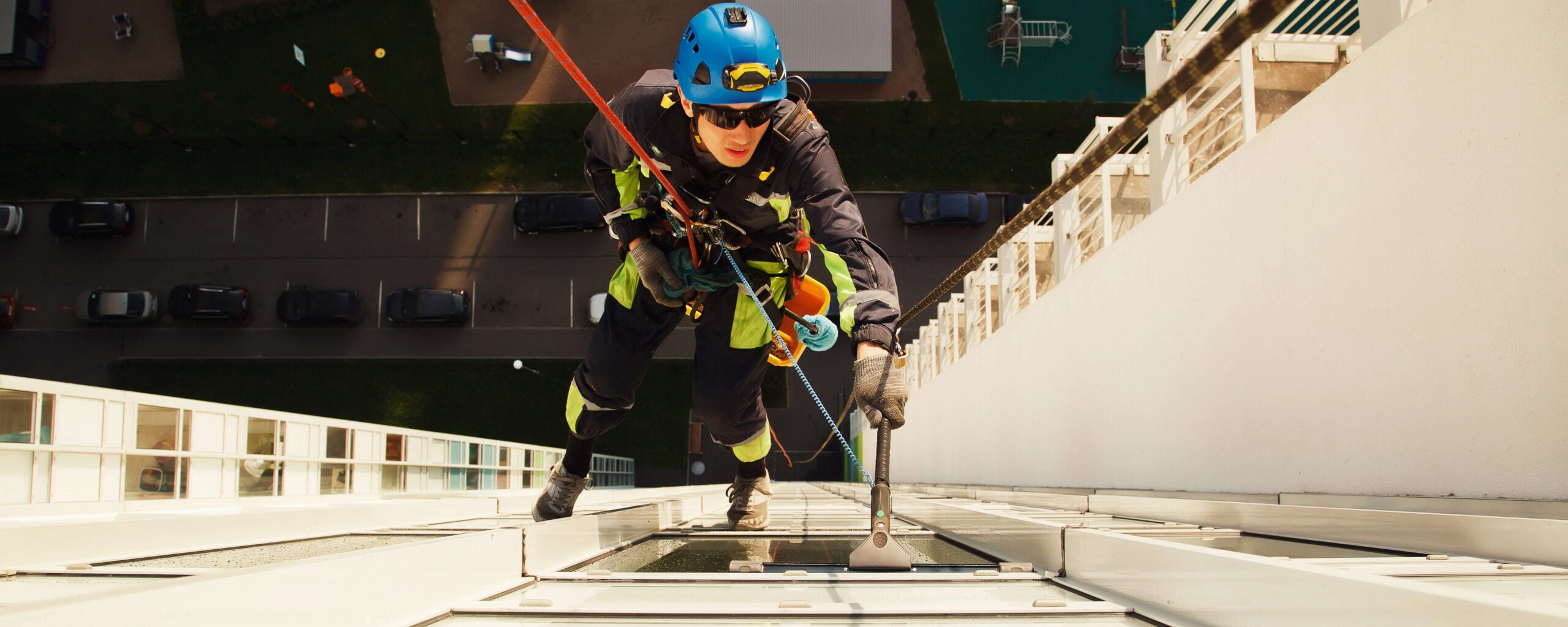
An emergency glazing make-safe is the rapid stabilisation of a damaged or failed glazing installation to eliminate an immediate risk to public safety or building security. When glass breaks, cracks through, or becomes structurally unsound at height, it presents a serious hazard: loose or unstable glass panels can fall, and a breached building envelope leaves the structure exposed to the elements and potentially to unauthorised entry.
A make-safe attendance prioritises removing that risk over permanent repair. The objective is to secure the building and protect people below, and to do so quickly. Permanent repair, which may involve glass procurement on a specific specification and a more involved installation process, follows once the immediate hazard is controlled.
GLRE provides emergency make-safe services for commercial buildings across the UK, deploying rope access and industrial abseiling teams to reach damaged glazing at any height, on any building type, as rapidly as possible after receiving a call.
Emergency make-safe is required whenever glazing damage creates an immediate risk that cannot wait for a planned repair programme. The most common situations are as follows.
| Situation | Why Make-Safe Is Required |
| Impact-damaged glass at height | Cracks radiating from an impact point can extend rapidly and unpredictably, particularly in toughened glass under thermal or wind stress. Unstable panels must be secured or removed before failure. |
| Spontaneous toughened glass breakage | Toughened safety glass occasionally shatters spontaneously due to nickel sulphide inclusions. When this occurs in a high-level panel, the resulting glass debris presents an immediate hazard below. |
| Storm or wind damage | High winds can dislodge, crack, or displace panels in aged or deteriorating glazing systems. Post-storm inspections frequently identify panels requiring urgent make-safe. |
| Glass canopy or overhead glazing failure | Any instability in overhead glazing, whether from impact, structural silicone failure, or fixing corrosion, is a priority make-safe situation given the direct risk to pedestrians below. |
| Break-in or vandalism damage | Deliberate damage to building glazing, whether at ground level or height, requires rapid make-safe to restore building security and prevent further weather ingress or access. |
| Structural silicone or fixing failure | Where a glass panel’s bonding or fixing system has partially failed, the panel may be loose even without visible glass breakage. This is a structural risk requiring immediate attention. |
When GLRE receives an emergency make-safe call, the first step is a brief telephone assessment to establish the nature of the damage, the building type, the height of the affected glazing, and whether an immediate risk to the public exists. This allows us to determine the appropriate team size, access method, and any specialist equipment required before departure.
On arrival, the IRATA Level 3 supervisor assesses the situation, designs the rope rig appropriate to the building and the location of the damage, and carries out the risk assessment. Works then proceed under continuous supervision. The actual make-safe operation depends on the nature of the glazing failure but typically involves one or more of the following.
Cordoning and temporary exclusion zone: The area below the damaged glass is isolated immediately on arrival, with physical barriers and signage preventing public access while works are carried out.
Glass stabilisation or temporary boarding: Where a panel is cracked but still in place, it may be possible to stabilise it with structural tape or film pending replacement. Where the glass is loose, displaced, or broken, it is removed safely and the aperture is temporarily boarded or sheeted to restore weather tightness and building security.
Glass removal and controlled lowering: Broken or unstable panels are removed using appropriate techniques for the size, weight, and location of the glass. For large high-level panels, this involves vacuum handling equipment and controlled lowering rigs to ensure the glass is brought to ground level safely.
Post-make-safe inspection: Once the immediate hazard is resolved, the supervisor assesses the surrounding glazing for secondary damage or instability. Any additional panels requiring attention are identified and reported to the client.
Condition report and permanent repair recommendation: Following the make-safe attendance, GLRE provides a written report documenting what was found, what was done, and what permanent repair is required, including the glass specification needed for the replacement order.
Response times depend on the location of the building relative to our nearest operational base and team availability at the time of the call. GLRE operates from offices in Manchester, Birmingham, London, Newcastle, and Glasgow, giving broad UK coverage with teams positioned across the country.
For buildings in and around our core service cities, same-day attendance is typically achievable for calls received during business hours. For calls received outside normal hours, our team will assess the situation and advise on the earliest possible attendance. Where a building is insecure or there is an active public safety risk, we treat the call as a priority regardless of time.
It is worth noting that temporary make-safe measures are in almost all cases achievable on the day of attendance, even where the permanent glass replacement must wait for procurement. This means buildings can be secured and hazards controlled quickly, with the permanent repair following once the correct glass specification has been confirmed and the panel manufactured.
Having the following information to hand when you call will help our team mobilise as quickly and efficiently as possible.
Even without all of this information, our team will work with what is available. The priority is getting the right people moving towards your building as quickly as possible.
Once the immediate hazard has been resolved and the building is secure, GLRE will confirm the glass specification required for the permanent replacement, advise on procurement lead times, and programme the permanent repair. In many cases the permanent repair can be scheduled within a few days to a couple of weeks of the make-safe, depending on the glass specification and supplier lead times.
Where the damage is attributable to a deficiency in the glazing system rather than an isolated incident, such as widespread structural silicone failure or a pattern of fixing corrosion, GLRE will advise on a wider inspection and remediation programme to address the underlying issue and prevent recurrence.
For emergency glazing make-safe on a commercial building, contact GLRE as soon as the situation is identified. Call our Manchester office on 0161 850 0605 or our Birmingham office on 0121 285 0543. For London and South East emergencies, call 0207 183 6551. Alternatively, use the contact form on our website and mark your enquiry as urgent.
Our team will assess your situation immediately and advise on the fastest available response.


GLRE © All Rights Reserved 2026