Statement leading to lead magnet.
GLRE covers the most common glass canopy problems, from sealant failure to cracked panels, and explains how specialist rope access repairs are carried out.

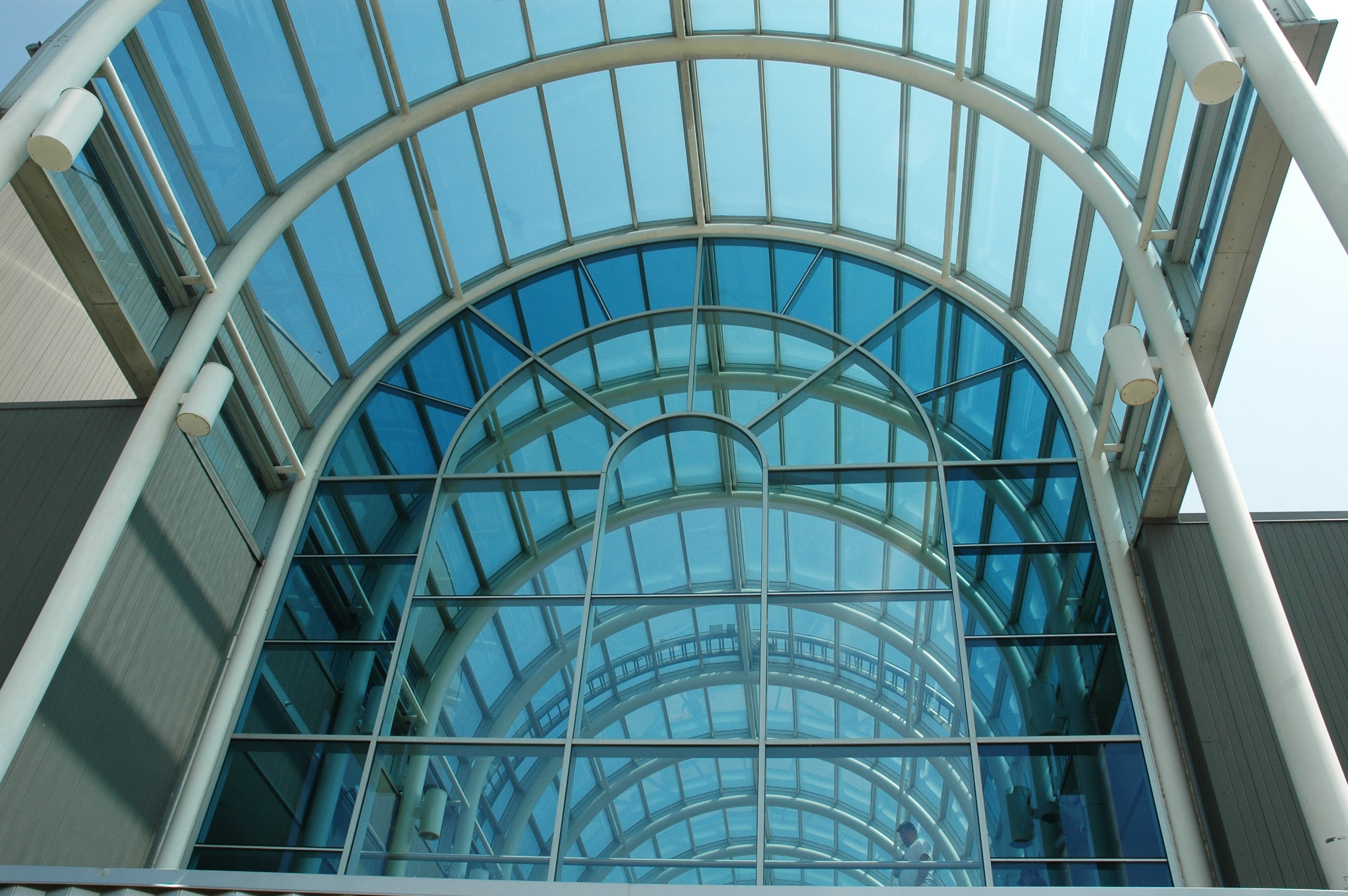
A glass canopy is a glazed overhead structure, typically projecting from a building’s facade above an entrance, walkway, car park, or loading bay. Canopies provide weather protection, define entry points, and contribute significantly to a building’s kerb appeal and first impressions. On commercial buildings, they are often structural glass installations involving toughened or laminated panels, structural silicone bonding, point fixings, or patent glazing systems.
Glass canopy repair requires a specialist for two reasons. Access is often the first obstacle: canopies sit at height or in positions that make conventional ladder or platform access impractical without significant disruption to foot traffic or vehicle movements below. And the repair itself demands glazing expertise, since canopy systems are engineered structures where incorrect sealant selection, improper glass specification, or poorly executed frame repairs can cause further damage, voiding any warranty, or in the worst case creating a structural risk.
GLRE combines rope access and industrial abseiling capability with nearly 30 years of commercial glazing expertise. Our teams carry out glass canopy inspections, repairs, and replacements on commercial buildings across the UK, using access methods that minimise disruption and repairs that are carried out to the correct specification for each canopy system.
Glass canopies are exposed to the full range of weather conditions as well as the mechanical stresses of a busy building entrance. The faults most frequently encountered fall into several categories.
| Problem | Detail |
| Failed or deteriorating sealant joints | Silicone sealant around the glass perimeter and at frame interfaces breaks down over time through UV exposure, thermal cycling, and movement. Cracked, shrunk, or adhesion-failed sealant allows water to penetrate behind the glass or into the frame, leading to further deterioration. |
| Cracked or broken glass panels | Impact damage from hailstones, wind-borne debris, or accidental contact can crack canopy glass. Because canopy panels are typically overhead, any loose or cracked glass presents a direct safety risk to people below and must be addressed as a priority. |
| Structural silicone bonding failure | On structural glass canopies, silicone bonding carries the weight and wind load of the panels. Adhesive degradation or incorrect original specification can cause bonding failure, which is a serious structural defect requiring immediate attention. |
| Point fixing corrosion | Spider fittings and bolt fixings used on frameless canopies are typically stainless steel, but in aggressive environments or where inferior grades have been used, corrosion develops. Corroded fixings reduce load-bearing capacity and affect the appearance of the canopy. |
| Frame corrosion and finish deterioration | Steel or aluminium framing is susceptible to corrosion where the protective finish has broken down. Surface corrosion is often cosmetic in early stages but will become structural if left untreated. |
| Condensation and misted sealed units | Where double-glazed panels are used, sealed unit failure leads to internal condensation. On a canopy, this is both an aesthetic issue and an indicator of reduced glass strength in some circumstances. |
| Drainage failure and standing water | Canopy drainage channels and outlets can become blocked with debris, causing standing water. Ponding water adds load to the structure and accelerates sealant and frame deterioration. |
An effective glass canopy inspection cannot be carried out adequately from ground level. Close-up assessment of sealant joints, fixings, frame condition, and glass integrity requires access to the canopy surface itself, which on most commercial buildings means rope access or an appropriately positioned mobile elevated work platform.
GLRE’s canopy inspections are carried out by IRATA-qualified rope access technicians under the supervision of a Level 3 supervisor. The inspection covers the condition of every glass panel, all sealant and gasket joints, structural bonding where present, fixings and hardware, frame members and their protective coatings, and drainage outlets and channels.
Following the inspection, we provide a written condition report identifying all defects, their severity, and our recommended repair approach. Where the canopy is part of a planned maintenance programme, this report feeds directly into the programme schedule. Where defects requiring urgent attention are identified, we advise immediately and can programme emergency works.
Repair method depends entirely on the fault identified. The following outlines how the most common canopy defects are addressed.
Sealant replacement: Failed sealant is cut out fully and joint faces are cleaned, degreased, and primed before new sealant is applied to the correct specification. For canopy applications, sealant selection must account for the exposure conditions, movement characteristics of the joint, and compatibility with the substrate materials. Colour matching is standard practice to maintain the canopy’s visual appearance.
Glass panel replacement: Cracked or broken panels are removed and replaced with glass cut to the original specification. For structural or overhead canopy glass, specification is critical: the replacement must match the original in terms of toughened or laminated build, thickness, and any coating. GLRE works with specialist glass suppliers and carries out panel changes using vacuum handling equipment where required to safely manage large or awkward panels at height.
Structural silicone reapplication: Where structural bonding has failed or is showing signs of deterioration, the affected panels are temporarily supported, the failed silicone is removed, surfaces are thoroughly prepared, and new structural silicone is applied to the manufacturer’s specification. Full cure time must be allowed before the temporary support is removed, which is typically up to 21 days depending on the product and conditions.
Fixing replacement: Corroded or damaged point fixings are replaced on a like-for-like basis, or upgraded to a higher-specification grade where the original installation used inappropriate materials. Where multiple fixings are corroded, a full replacement programme is usually more cost-effective than piecemeal repairs.
Frame treatment and refinishing: Corroded frame sections are treated, primed, and refinished in a high-performance coating suited to an exposed overhead application. Where corrosion has compromised a structural member, replacement is specified.
Drainage clearance: Blocked outlets are cleared and channel falls checked. Any damaged drainage components are replaced to restore proper water management across the canopy surface.
In many cases, yes, though this depends on the nature of the work and the specific canopy configuration. For sealant repairs and minor works, our teams can typically work without closing the entrance below, with appropriate cordoning, signage, and ground marshals in place to protect the public.
For glass panel replacement or structural silicone works, a temporary closure of the area directly below is usually required during the lift and handling of the panel. In most commercial buildings this can be managed with short-duration closures coordinated around building traffic patterns, minimising inconvenience to occupants and visitors. GLRE’s teams are experienced in working on busy commercial entrances and understand that prolonged closures are not acceptable on most live sites.
The cost of glass canopy repair varies depending on the nature and extent of the defects identified, the access requirements, and the specification of any replacement materials. Sealant repair programmes are typically straightforward and cost-effective relative to the value they protect. Glass panel replacements involve material procurement costs in addition to access and labour.
The most cost-effective approach in almost all cases is a planned inspection and maintenance programme that identifies defects early and addresses them before they escalate. A sealant joint replaced at the first sign of deterioration costs a fraction of the remediation required after water ingress has caused frame corrosion, staining, or structural damage.
GLRE provides free site surveys for glass canopy inspections and repair quotations. To arrange a survey, contact our team directly.
If your building has a glass canopy that is showing signs of deterioration, has sustained damage, or is simply due for its periodic inspection, contact GLRE to arrange a free survey. Our team will assess the canopy, identify any defects, and provide a clear repair recommendation and quotation.
To speak to a specialist or book a survey, contact GLRE on 0161 850 0605 or visit our contact page. We work with commercial property managers, facilities managers, and building owners across the UK.


GLRE © All Rights Reserved 2026