Statement leading to lead magnet.

Industrial abseiling is a professional method of working at height in which trained operatives use ropes and specialised equipment to access, inspect, and carry out maintenance or repair work on the exterior of buildings and structures.

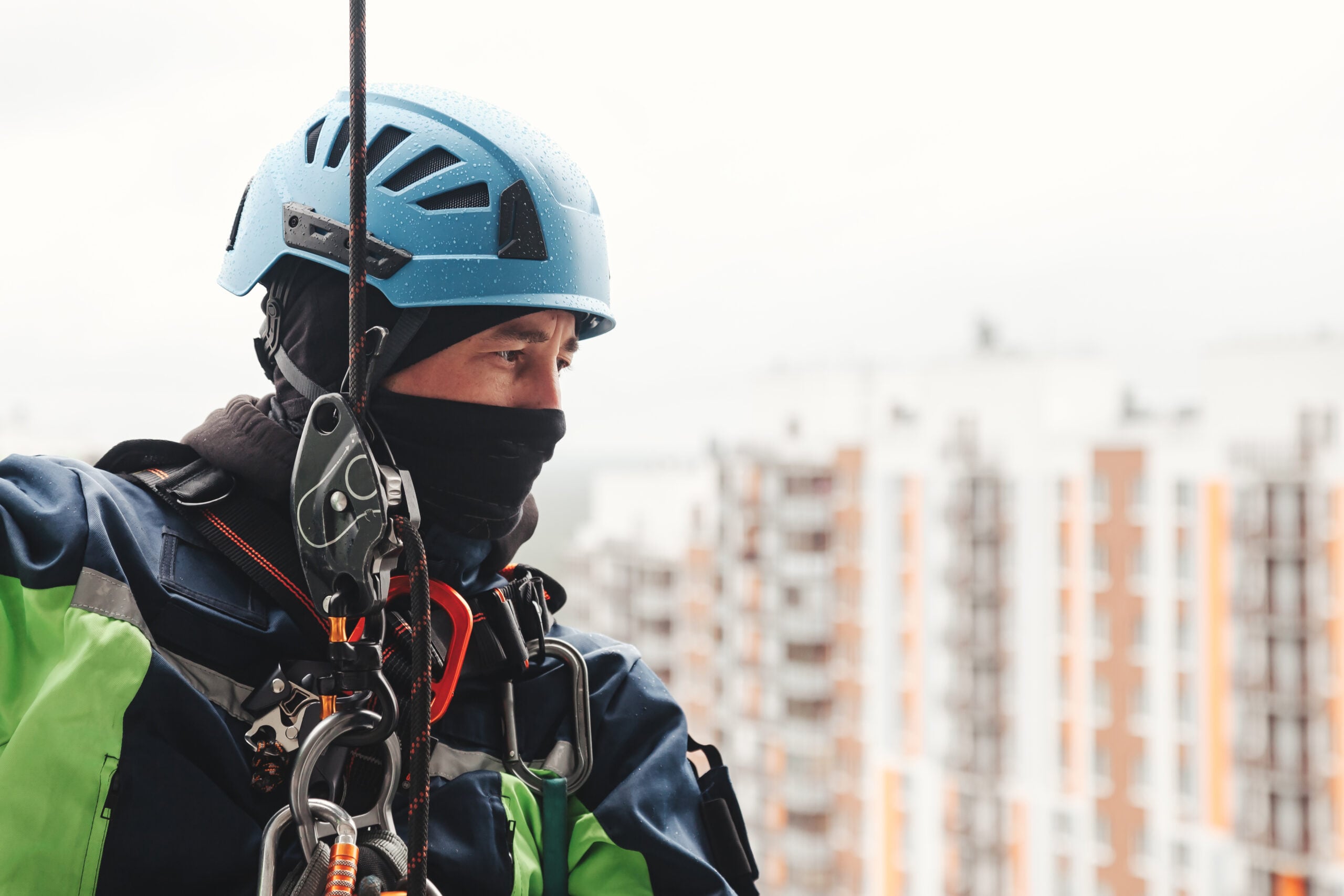
Industrial abseiling is a professional method of working at height in which trained operatives use ropes and specialised equipment to access, inspect, and carry out maintenance or repair work on the exterior of buildings and structures. It is used across commercial construction and facilities management as a safe, efficient, and cost-effective alternative to scaffolding or mobile elevated work platforms. On multi-storey commercial buildings, industrial abseiling is most commonly applied to glazing repair, cladding maintenance, sealant replacement, leak investigation, and high-level cleaning.
The terms are often used interchangeably, and in practice they refer to the same category of work. Industrial abseiling describes the physical act of descending a structure using a rope system, while rope access is the broader discipline that includes ascending, traversing, and working in position at height.
Both fall under the governance of IRATA International, the globally recognised body that sets training, certification, and safety standards for industrial rope access operatives. When a contractor describes their team as rope access technicians or industrial abseilers, they should hold IRATA certification to one of three levels.
In short: industrial abseiling and rope access refer to the same category of professional work at height. The key differentiator between a qualified contractor and an unqualified one is IRATA certification.
A qualified team sets up a rope system from a fixed anchor point at the top of the building, typically using permanent eyebolts or temporary rigging points. Each technician works on two independent lines: a working line they descend on, and a separate safety line. This two-rope system is a core requirement of the IRATA safety standard.
Before any operative descends, a Level 3 IRATA supervisor designs the rope rig, carries out a risk assessment, and approves the system. All lines, connections, harnesses, and equipment are inspected at the start of every shift and after every break. The team works within a cordoned exclusion zone at ground level.
Once in position on the face of the building, operatives can carry out a wide range of tasks including glass replacement, sealant application, cleaning, inspection, and cladding repair, using the same tools and materials used in conventional access situations.
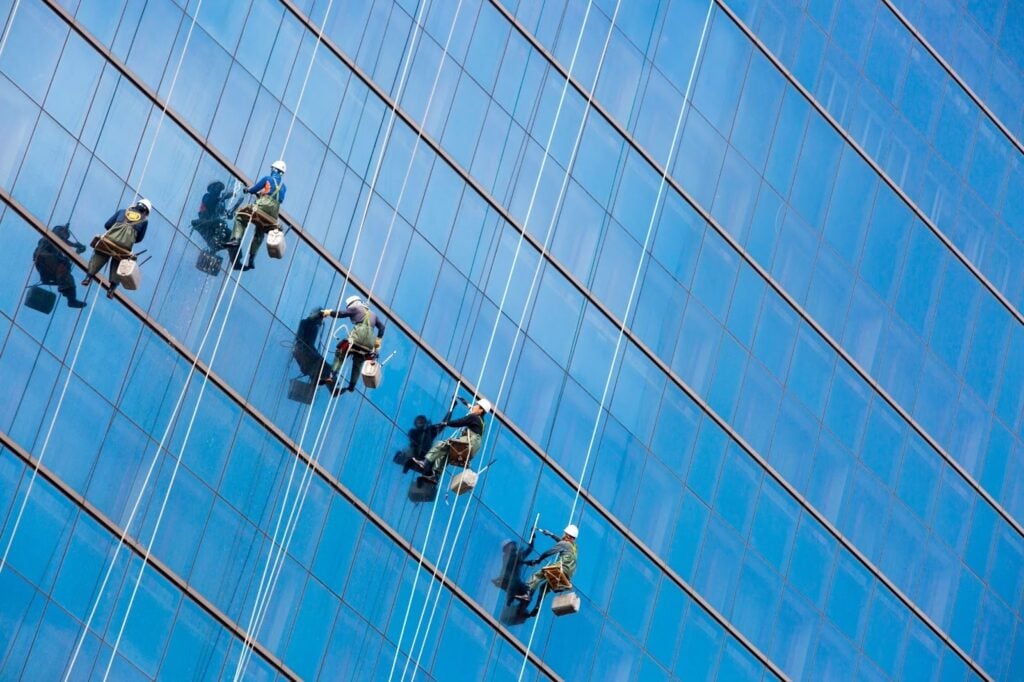
Industrial abseiling gives access to virtually any point on the exterior of a commercial building. The most common applications include:
Facilities managers and building owners typically consider three access options when planning high-level maintenance works. The table below sets out the key practical differences:
| Industrial Abseiling / Rope Access | Scaffolding | MEWP (Cherry Picker) | |
| Mobilisation time | Hours to days | Days to weeks | Hours to days |
| Cost | Generally lower | Generally higher | Variable |
| Disruption to site | Minimal | Significant | Moderate |
| Access to complex facades | Yes | Limited | Limited |
| Suitable for enclosed spaces | Yes | Rarely | No |
| Works at full building height | Yes | Yes | Dependent on platform height |
| Planning permission typically required | No | Sometimes | Sometimes |
Note: this table is a general guide. The most appropriate access method for any project depends on the specific scope of works, building type, and site conditions. GLRE carries out a pre-works survey to advise on the right approach for every project.
IRATA certification is the recognised standard for industrial abseiling and rope access operatives in the UK and internationally. There are three levels, each requiring a defined number of supervised working hours and a formal assessment. Contractors working on commercial buildings should be able to confirm their team’s certification status.
Entry-level certification. A Level 1 technician can work at height under the direct supervision of a Level 3 supervisor. They have completed the foundation training and can carry out tasks once the rope system has been rigged and approved.
An intermediate certification. Level 2 technicians have accumulated a minimum of 1,000 hours of logged rope access work and can assist with supervision and some rigging tasks. They work under the authority of a Level 3 supervisor on site.
The most senior certification. A Level 3 supervisor is responsible for designing the rope rig, carrying out the risk assessment, approving all equipment, and authorising the team to work. A minimum of 1,000 hours at Level 2 is required to sit the Level 3 assessment. On every rope access project, GLRE deploys a qualified Level 3 supervisor as standard.
Industrial rope access carried out by IRATA-certified technicians is a well-established and rigorously governed method of working at height. The two-rope system, pre-shift equipment checks, Level 3 supervision, and mandatory exclusion zones are all safeguards built into the IRATA standard.
Building owners commissioning rope access works should look for contractors holding recognised health and safety accreditations alongside IRATA certification. GLRE holds CHAS Elite, SafeContractor, and Constructionline Platinum accreditations, and is ISO 9001:2015 certified. These are independently audited standards that verify quality management systems, not just on-site safety procedures.
For buildings with existing fall arrest infrastructure, such as eyebolt systems, the rope access team can integrate with the fixed anchor network. Where eyebolts do not exist or have not been recently tested, GLRE can arrange inspection and certification as part of the pre-works process.
Industrial abseiling is applicable to any multi-storey building with an exterior that requires maintenance or repair. In practice, the buildings where rope access delivers the clearest operational advantage tend to share certain characteristics:
GLRE has worked on projects including NHS hospitals, shopping centres, and major commercial offices across the UK. More detail is available in our completed projects section.
When appointing a rope access or industrial abseiling contractor for commercial building maintenance, the following should be confirmed before works begin:
As a rope access specialist with nearly 30 years of experience, GLRE provides method statements, risk assessments, and photographic completion reports on every project. Our teams operate across Manchester, Birmingham, London, Leeds, Liverpool, Newcastle, and Glasgow.
Rope access is not restricted by building height in the way that some access platforms are. Provided the appropriate anchor system is in place and the correct rope lengths are used, industrial abseilers can work at any height on the exterior of a commercial building.
In most cases the building does not need to be vacated. Works are carried out from the outside, and a cordoned exclusion zone at ground level protects occupants and passers-by. GLRE works on occupied commercial buildings and coordinates with building management teams to minimise disruption.
For planned maintenance works, mobilisation timelines depend on the scope of the project and pre-works survey requirements. For emergency make-safe situations involving failed or dangerous glazing, GLRE can mobilise rapidly to make the building safe.
Yes. GLRE always carries out a pre-works site survey before any rope access project commences. This allows the Level 3 supervisor to design the appropriate rope rig, assess anchor points, and produce the risk assessment and method statement for the specific site.
To find out whether industrial abseiling is the right solution for your building maintenance project, contact the GLRE team to book a free site survey. Our IRATA-qualified rope access specialists are ready to assess your building and advise on the most effective approach.


GLRE © All Rights Reserved 2026