Statement leading to lead magnet.

Abseil cleaning is a method of cleaning the exterior of commercial buildings at height using IRATA-qualified rope access operatives who descend the facade on a controlled rope system.


Abseil cleaning is a method of cleaning the exterior of commercial buildings at height using IRATA-qualified rope access operatives who descend the facade on a controlled rope system. It differs from traditional window cleaning in that it can safely reach glazing, cladding, and other surfaces at any height on a commercial building, without the need for scaffold, cherry picker, or extendable pole equipment. For multi-storey commercial buildings where ground-level or platform access cannot safely reach all surfaces, abseil window cleaning via a qualified rope access contractor is the standard professional solution.
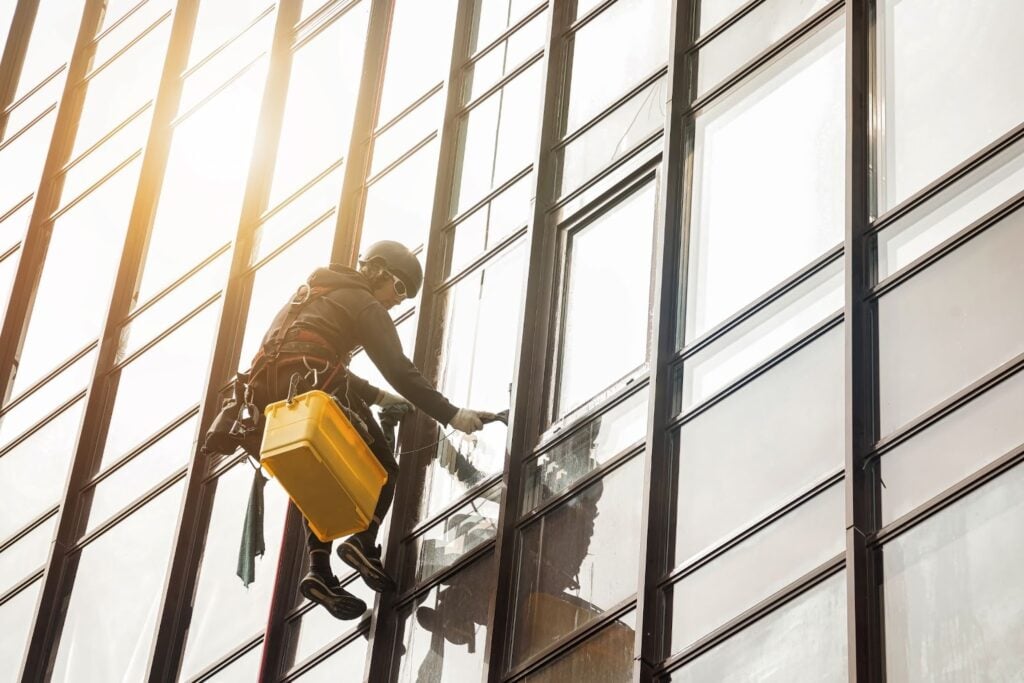
Abseil cleaning, also referred to as rope access window cleaning or high-level cleaning, involves trained operatives descending a building on a two-rope system to clean glazing, cladding, and facade surfaces from the outside. Each operative works on an independent working line and a separate safety line, as required under the IRATA International standard for industrial rope access.
A Level 3 IRATA supervisor designs the rope rig, carries out a risk assessment, and approves all equipment before any operative descends. The team works systematically across the building face, cleaning each section before moving to the next anchor position.
Abseil cleaning can be carried out on any building surface accessible from the roof or from anchor points on the structure, including vertical glazed facades, curtain walling, structural glass canopies, cladding panels, and atrium glazing inside enclosed structures.
Traditional commercial window cleaning covers a range of access methods used for buildings where rope access is not required. The most common methods include:
Each of these methods has practical limitations in terms of height, building geometry, and site conditions. When a commercial building exceeds the reach of pole systems and ground conditions or access routes prevent MEWP deployment, abseil cleaning becomes the appropriate access solution.
The table below sets out the main practical differences between abseil cleaning via rope access and the most common traditional window cleaning methods:
| Abseil / Rope Access | Water-Fed Pole | MEWP | |
| Maximum working height | Unlimited, subject to anchor points | Typically up to 5 storeys | Dependent on platform height and model |
| Ground space required | Exclusion zone only | Minimal | Significant footprint required |
| Suitable for complex facades | Yes | Limited | Limited |
| Suitable for atria and enclosed spaces | Yes | No | No |
| Disruption to building occupants | Minimal | Minimal | Moderate |
| Certification required | IRATA (mandatory) | None specified | IPAF recommended |
| Suitable for occupied buildings | Yes | Yes | Usually |
Note: this table is a general guide. The most appropriate cleaning method depends on the specific building, access conditions, and height involved. GLRE carries out a pre-works site survey to confirm the right approach before any works begin.
Abseil cleaning via rope access is appropriate in the following situations:
Combining a cleaning visit with a facade inspection or sealant condition check is an efficient use of mobilisation costs. GLRE regularly carries out combined cleaning and inspection programmes for commercial building owners as part of a planned maintenance schedule.
GLRE’s high-level cleaning service covers all external commercial building surfaces accessible via rope access. The most commonly cleaned surface types include:
Any commercial contractor carrying out window cleaning via rope access on a UK commercial building should hold IRATA certification. This is the internationally recognised standard for industrial rope access and covers the training, assessment, and working practices that rope access operatives must follow.
IRATA certification runs across three levels. Level 1 operatives work under direct supervision from a Level 3 supervisor. Level 2 technicians have accumulated a minimum of 1,000 hours of logged rope access work. Level 3 supervisors are responsible for rope rig design, risk assessment, equipment inspection, and authorising the team to work on every shift.
Building managers commissioning abseil window cleaning should also look for contractors holding independently audited health and safety accreditations such as CHAS, SafeContractor, or Constructionline, alongside IRATA certification. GLRE holds CHAS Elite, SafeContractor Approved, and Constructionline Platinum status, as well as ISO 9001:2015 quality management certification.
Cleaning frequency for commercial glazing depends on several factors including the building’s location, the level of atmospheric pollution in the area, the type of glazing system, and the building owner’s maintenance obligations. There is no single universal standard that applies to all commercial buildings.
Buildings in urban or city centre locations, close to busy roads or industrial activity, typically accumulate surface deposits more quickly than those in lower-pollution environments. GLRE’s blog post on how air pollution drives high-level cleaning schedules covers this topic in more detail for building managers planning a cleaning programme.
As a general principle, a pre-planned cleaning schedule agreed with a qualified rope access contractor, combined with periodic condition surveys, allows building owners to budget predictably and maintain the appearance and integrity of the building envelope.
Industrial rope access cleaning carried out by IRATA-certified operatives is a well-established and rigorously governed method of working at height. The two-rope system, mandatory pre-shift equipment checks, Level 3 supervision, and cordoned exclusion zone at ground level are all safety requirements built into the IRATA standard rather than optional measures.
The exclusion zone established at ground level prevents building occupants and members of the public from entering the area directly below the works. Signage and, where required, IRATA-qualified ground marshals are deployed to manage the cordon during the working period.
In most cases the building does not need to be vacated or operations suspended during abseil cleaning. GLRE coordinates with building management teams prior to works to agree access arrangements and notify occupants where relevant.
The two terms refer to the same activity. Abseil cleaning describes the physical method of descending the building on a rope to carry out cleaning, while rope access window cleaning is the broader term used by contractors and procurement teams. Both involve IRATA-certified operatives and the same two-rope safety system.
Yes, and this is often a cost-effective approach. GLRE regularly combines cleaning visits with building envelope inspections, sealant condition surveys, or minor glazing repairs within the same mobilisation. Combining works reduces overall contractor costs and minimises the number of times building access arrangements need to be coordinated.
No. Abseil cleaning is carried out from the exterior of the building. A ground-level exclusion zone is established, but internal operations continue normally. GLRE works on occupied commercial buildings and public buildings as a matter of routine.
The first step is to contact GLRE to arrange a free site survey. A Level 3 IRATA supervisor will assess the building, confirm the access method, and provide a written quotation covering the full scope of cleaning works.To arrange abseil window cleaning or a high-level cleaning survey for your commercial building, contact the GLRE team today. Our IRATA-qualified rope access cleaners work on commercial buildings of all heights across the UK.



GLRE © All Rights Reserved 2026