Statement leading to lead magnet.

Find out when safety netting is required for commercial buildings, the types, and how rope access teams install it safely. Book a free survey today.

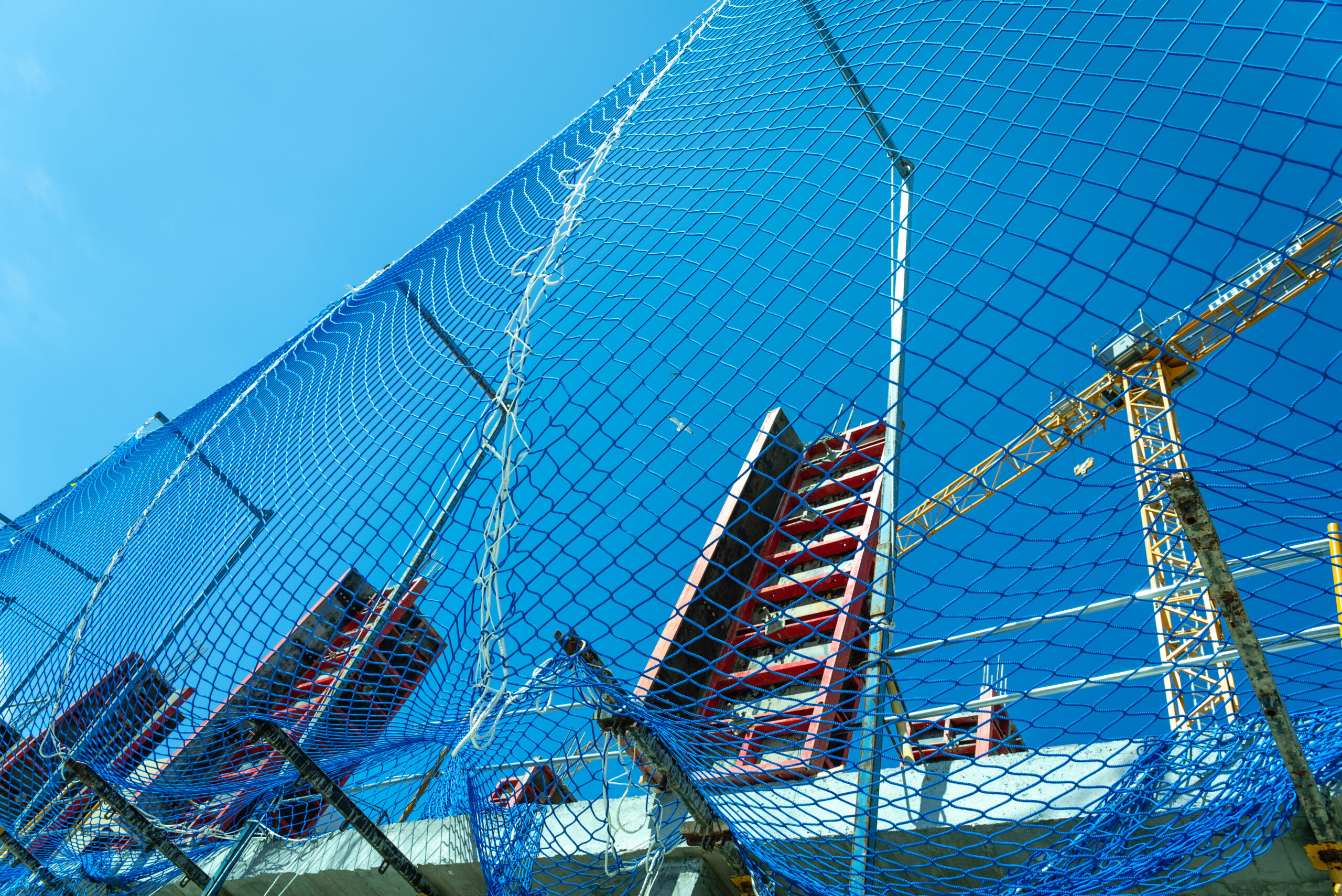
Safety netting for commercial buildings is a temporary protective system installed at height to catch falling persons, tools, or debris during construction, maintenance, or repair works. It provides a passive fall-arrest solution that protects both workers operating above and members of the public or building occupants below. For building owners and facilities managers commissioning rope access or high-level maintenance works, understanding when safety netting is required, the types available, and how it is installed and removed will help ensure your project meets its health and safety obligations from the outset.
Safety netting is a form of collective fall protection. Unlike personal protective equipment such as harnesses and lanyards, which protect individual workers, safety netting is installed beneath or around a work area to provide a physical barrier that catches anything that falls. When correctly specified and installed, a safety net absorbs the energy of a falling load or person, limiting the forces transmitted to the structure and reducing the risk of injury.
Safety nets used on construction and maintenance sites in the UK must comply with BS EN 1263, the British and European standard that sets out requirements for materials, mesh dimensions, energy absorption, and testing. Only nets that meet this standard should be used on commercial building projects.
Safety netting is not required on every project. The need for it is determined by a risk assessment that considers the nature of the works, the access method being used, the proximity of the public or other workers, and whether alternative collective or individual protection measures are adequate. Safety netting is most commonly specified in the following situations:
Under the Work at Height Regulations 2005, employers and those in control of work at height have a duty to prevent falls where reasonably practicable, or, where this is not possible, to mitigate the consequences. Safety netting is one of the recognised means of fulfilling this mitigation duty and should be considered as part of the overall method statement for any high-level commercial works.
Safety nets are categorised by their intended installation method and the type of protection they provide. The main types relevant to commercial building maintenance and repair are:
Vertical nets are installed in a vertical plane, typically around the perimeter of a building or scaffold structure. They serve primarily as debris containment systems, preventing materials, tools, or glass fragments from falling into public areas below. They do not provide fall arrest protection for workers but are widely used in conjunction with other fall protection measures during facade and glazing works.
Horizontal safety nets installed in accordance with BS EN 1263 are designed to arrest the fall of a person working above. They are suspended horizontally below the work area, with the clearance distance between the net and the surface above calculated to ensure the net has sufficient deflection to absorb the energy of a fall. These are commonly used in roof-level works and atrium projects where working beneath is not feasible.
Debris netting is a lighter-weight mesh system designed specifically for containing small particles, dust, and minor fallout during maintenance works. It does not provide fall arrest capability and should not be used as a substitute for a safety net meeting BS EN 1263. Debris netting is often used alongside other protective measures where the primary concern is preventing small fragments or dust reaching occupied areas below.
Selecting the right fall protection approach depends on the nature of the works, the building configuration, and the risks involved. The table below outlines how safety netting relates to other common methods:
| Protection Method | Type | Best Suited For |
| Safety netting (BS EN 1263) | Collective, passive | Arrest of falls and debris containment over large areas |
| Harness and lanyard | Personal, active | Individual worker protection during rope access or elevated works |
| Rigid edge protection / barriers | Collective, passive | Perimeter protection on flat roofs and elevated platforms |
| Exclusion zones and barriers | Administrative control | Protecting ground-level public from falling debris |
| Safety decking / temporary platforms | Collective, passive | Working platforms providing both access and fall prevention |
In practice, commercial building maintenance projects often use a combination of these measures. A rope access technician working at height will use a personal harness and safety line as primary protection, while safety netting and ground-level exclusion zones provide secondary and tertiary layers of protection for those below.
Under the Construction (Design and Management) Regulations 2015 (CDM 2015), the responsibility for ensuring adequate fall protection is shared between the client, the principal contractor, and the contractor carrying out the works. For building maintenance projects, the contractor or specialist rope access company carrying out the work typically takes responsibility for specifying and installing appropriate fall protection as part of their method statement and risk assessment.
Safety net installation must be carried out by competent personnel. The Health and Safety Executive (HSE) recommends that safety net riggers hold a recognised industry qualification for net installation, such as that provided by the Safety Net Contractors Association (SNCA). Where safety netting forms part of a wider rope access project, it should be included within the scope of the IRATA Level 3 supervisor’s pre-works planning and inspection.
As the building owner or facilities manager, your duty under CDM 2015 as a client includes ensuring that those you appoint have the necessary competence and resource to carry out the works safely. Checking that your contractor addresses fall protection, including safety netting where required, within their method statement is an important part of discharging this duty.
For high-level commercial buildings where scaffold access is impractical, safety netting is typically installed and removed using rope access. IRATA-qualified rope access technicians are well suited to this task, as they can access the required anchor points and install net support systems on virtually any building geometry without the need for ground-based access equipment.
The installation process typically follows these steps:
1. Anchor point inspection. Existing anchor points or eyebolts are inspected to confirm they are rated for the additional loads imposed by the netting system. Where additional anchors are required, these are installed and tested before the netting works commence.
2. Net support system installation. The support frame or suspension system for the net is rigged using the confirmed anchor points. The configuration is designed to provide the required clearance below the net and the correct deflection characteristics for the fall arrest specification.
3. Net deployment and securing. The safety net is deployed and secured to the support system. All connections, edge fixings, and tie points are checked against the installation specification. The completed installation is inspected and signed off before works above commence.
4. Inspection during works. The net is visually inspected regularly during the works. If the net arrests a fall or receives significant impact from debris, it must be inspected before works above can resume and replaced if any damage is identified.
5. Removal and disposal. On completion of the works above, the net is removed using the same rope access methodology. Nets that have arrested a fall must be removed from service and should not be re-used without assessment by the manufacturer or a qualified specialist.
When commissioning high-level maintenance or repair works where safety netting may be required, building managers should confirm the following with their contractor before works begin:
These checks sit alongside the broader contractor vetting process. Confirming that your contractor holds relevant health and safety accreditations, including CHAS Elite, SafeContractor, or equivalent, provides additional assurance that their safety management systems meet recognised standards.
GLRE provides safety netting as part of its wider range of rope access services for commercial buildings across the UK. Where the risk assessment for a project requires netting, it is scoped and installed as an integrated part of the overall works programme, using the same IRATA-qualified teams that carry out the glazing, cladding, and building envelope repair work.
This integrated approach means that the method statement, anchor point inspection, and safety netting installation are all managed within a single, coherent health and safety framework. Building managers benefit from a single point of contact and accountability for all aspects of the works, rather than co-ordinating separate contractors for access, repairs, and fall protection.
GLRE also provides related services including eyebolt installation and testing, which ensures that the anchor infrastructure needed to support safety netting and rope access operations is correctly installed, rated, and maintained. For buildings where eyebolt provision is inadequate, this work can be scoped as part of the same project.
GLRE delivers safety netting and fall protection solutions as part of its rope access services nationwide, operating from bases in Manchester, London, Birmingham, Leeds, Newcastle, and Glasgow. Our teams work on commercial buildings of all types, from office complexes and shopping centres to hospitals and civic buildings.
We provide rope access services across Manchester and rope access in Birmingham, with the same IRATA-governed safety standards and rapid mobilisation capability applied to every project, wherever it is located.
To discuss safety netting requirements for an upcoming project or to arrange a free site survey, contact the GLRE team today and speak directly with an IRATA-qualified specialist.



GLRE © All Rights Reserved 2026