Statement leading to lead magnet.
GLRE explains what high-level cleaning involves, which building elements need it, how often, and why rope access is the right method. Contact us for a free survey.

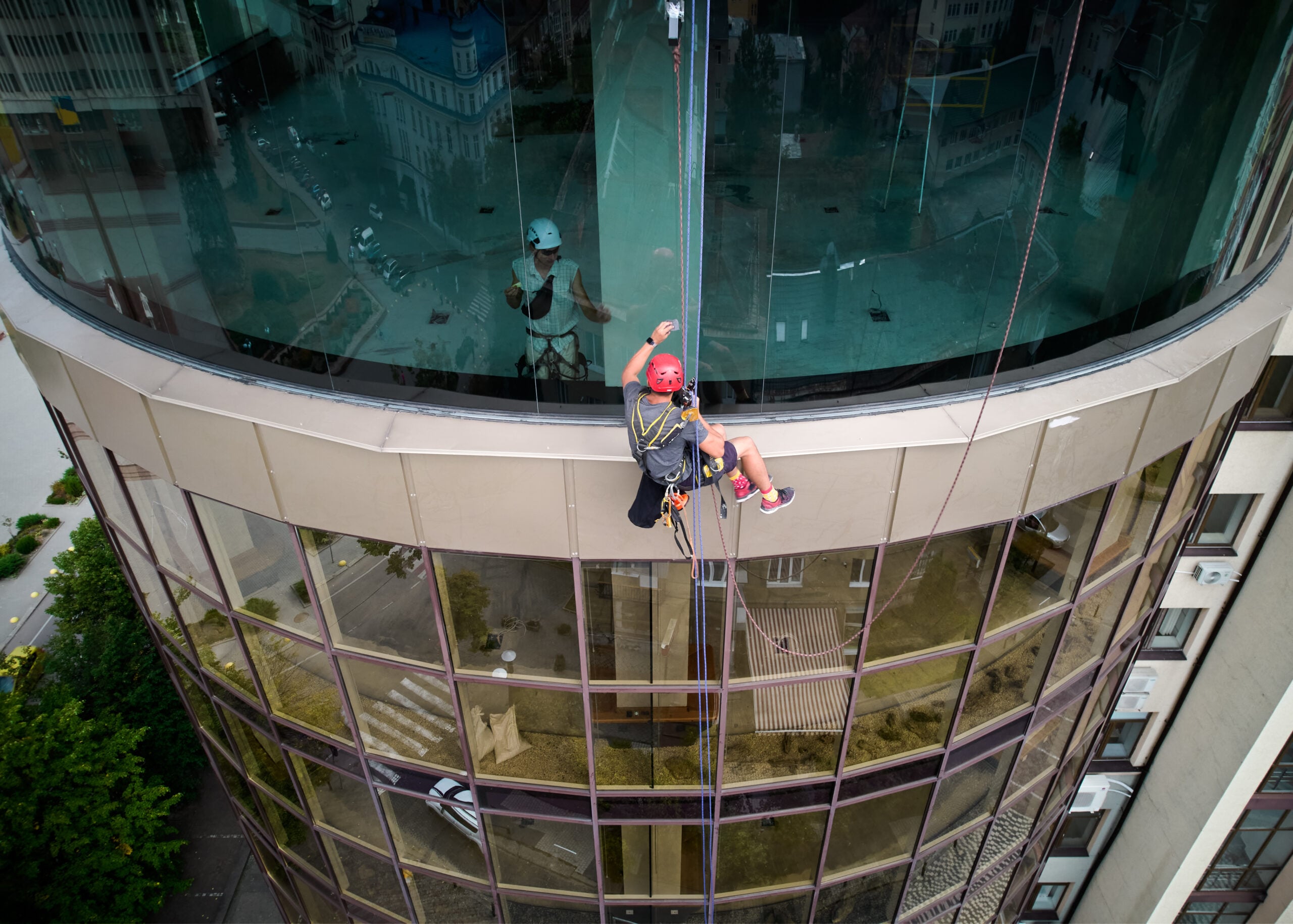
High-level cleaning refers to the cleaning of building elements that cannot be reached safely from ground level or by standard means. On commercial buildings, this includes window and glazing cleaning at height, facade cleaning to remove atmospheric staining, moss, algae, and biological growth, cleaning of cladding and curtain wall systems, gutters and drainage channels at height, atrium glazing, glass canopies, and high-level internal surfaces such as roof structures, mezzanines, and exposed steelwork.
The defining characteristic of high-level cleaning is the access challenge rather than the cleaning itself. Reaching height safely on a commercial building requires either rope access and industrial abseiling, mobile elevated work platforms (MEWPs) where ground conditions and building layout allow, or other specialist access techniques. GLRE’s high-level cleaning service uses rope access as its primary method, giving us the flexibility to work on tall buildings, complex facades, atrium roofs, and restricted-access areas where other access methods are impractical or prohibitively expensive.
With IRATA-qualified technicians and nearly 30 years of experience on commercial buildings across the UK, GLRE delivers high-level cleaning that combines safe, compliant access with effective cleaning outcomes for even the most demanding building facades.
GLRE’s high-level cleaning capability covers a broad range of building elements and cleaning requirements.
| Cleaning Type | Detail |
| High-level window and glazing cleaning | Cleaning of windows, curtain wall glazing, and glass facades at any height, using rope access to reach panels that cannot be accessed by conventional window cleaning methods. Suitable for office towers, hotels, retail centres, and residential buildings. |
| Facade and cladding cleaning | Removal of atmospheric soiling, carbon deposits, biological growth (moss, algae, lichen), and staining from stone, brick, render, metal cladding, and composite panel systems. Cleaning method is matched to the substrate to avoid damage. |
| Atrium and roof glazing cleaning | Internal and external cleaning of atrium glazing, roof lights, and glazed canopies where access from the ground or standard platforms is not possible. Regular cleaning of overhead glazing maintains light transmission and building appearance. |
| Gutter and drainage cleaning at height | Clearance of blocked or debris-laden gutters, downpipes, and drainage channels on multi-storey buildings. Regular cleaning prevents overflow, water ingress, and the accelerated deterioration of roofline and facade elements. |
| Bird fouling removal and decontamination | Safe removal of bird fouling from high-level ledges, sills, parapets, and mechanical plant at height. Bird fouling is corrosive to building materials and presents a health hazard; specialist decontamination is required, not standard cleaning. |
| High-level internal cleaning | Cleaning of internal high-level surfaces in warehouses, factories, sports halls, atria, and other large-span structures, including structural steelwork, roof trusses, and high-level pipework and plant. |
For buildings above approximately four storeys, conventional window cleaning methods, including reach-and-wash poles and trad cleaning from ladders, simply cannot reach the glazing safely or effectively. Mobile elevated work platforms are an option for lower to mid-rise buildings in locations where ground conditions are suitable and the platform can be positioned adjacent to the facade, but they cannot be used on all building types and are not appropriate for atrium roofs or complex facade geometries.
Rope access overcomes these limitations. It requires only a suitable anchor system, which most modern commercial buildings have installed, and can be deployed on virtually any building regardless of height, shape, or ground-level access constraints. It is also highly cost-effective for both one-off cleans and regular maintenance programmes, since mobilisation is quicker and cheaper than equivalent scaffold or MEWP solutions for multi-storey buildings.
For building owners and facilities managers who need to maintain the appearance and condition of a commercial building efficiently and without disruption, rope access high-level cleaning is the standard solution.
Cleaning frequency depends on the building’s location, facade material, and the appearance standards required by the building owner or occupier. There is no universal requirement, but the following gives a practical guide.
| Building Type / Condition | Typical Cleaning Frequency |
| City-centre office or retail in high-pollution environment | Quarterly to twice yearly for glazing; annual facade clean |
| Suburban commercial building | Annual glazing clean; facade clean every 2-3 years or as needed |
| Buildings in high-biological-growth environments (near vegetation, coastal) | More frequent cleaning to manage moss, algae, and lichen growth |
| Atrium and roof glazing (light transmission critical) | Twice yearly minimum; quarterly for high-profile or high-transparency installations |
| Gutter and drainage cleaning | Annually as a minimum; twice yearly recommended for buildings surrounded by trees |
| Buildings with high-fouling bird populations | As required, with follow-up deterrent installation to reduce recurrence |
The most cost-effective approach is to incorporate high-level cleaning into a planned maintenance programme alongside other building envelope inspections. GLRE regularly combines cleaning with inspection and minor repair works in a single mobilisation, which reduces access costs and ensures that any defects identified during cleaning are reported and can be addressed promptly.
Cleaning method is matched to the substrate and the type of soiling or contamination being removed. Using an inappropriate method risks damaging the surface, particularly on sensitive materials such as polished stone, powder-coated aluminium, or structural glass.
Pure water cleaning: For glazing and smooth cladding surfaces, pure water fed through a brush head is highly effective and leaves no residue or streaking. GLRE’s rope access technicians can use water-fed systems at height, supplied via a hose from a ground-level unit or a backpack system where hose runs are impractical.
Pressure washing: Appropriate for robust substrates including concrete, brick, and certain metal cladding systems. Pressure and nozzle configuration are matched to the substrate to clean effectively without causing damage. Not suitable for aged or fragile render, polished stone, or areas with compromised sealant joints.
Soft wash: A low-pressure application of biodegradable cleaning solutions designed to kill and remove biological growth, including moss, algae, and lichen, without the mechanical action of pressure washing. Particularly effective for porous substrates such as stone and render where pressure washing risks surface damage.
Manual cleaning with specialist solutions: For surface types requiring careful treatment, including coated glass, anodised aluminium, and polished stone, manual application of appropriate cleaning solutions by rope access technicians gives precise control over the process.
If your building requires high-level window cleaning, facade cleaning, atrium cleaning, gutter clearance, or any other high-level cleaning service, contact GLRE to discuss your requirements and arrange a free site survey. We will assess your building, recommend the appropriate cleaning method and frequency, and provide a competitive quotation.
To speak to our team or book a survey, contact GLRE on 0161 850 0605 or visit our contact page. We work with commercial property managers, facilities managers, and building owners on buildings of all types across the UK.



GLRE © All Rights Reserved 2026