Statement leading to lead magnet.

Discover how rope access building maintenance contracts work, what they include, and what to expect long-term. Get a free site survey from GLRE today.

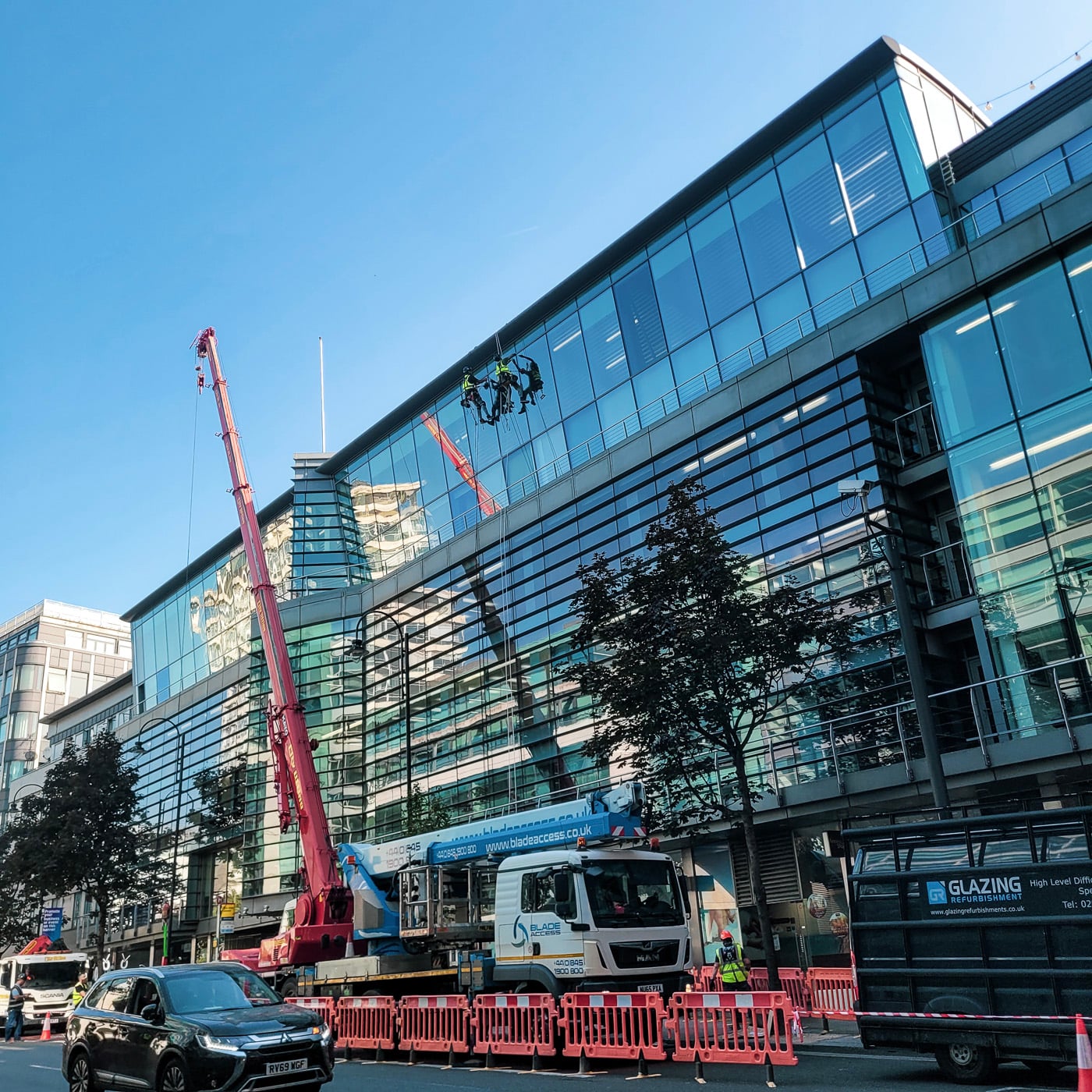
A rope access building maintenance contract is an ongoing agreement between a commercial building owner or facilities manager and a rope access contractor to carry out regular inspection, maintenance, and repair work on the external fabric of a building. Rather than commissioning individual reactive jobs as defects arise, a planned maintenance contract provides a structured programme of work, typically covering glazing, cladding, sealant, cleaning, and envelope condition monitoring on a scheduled basis throughout the year.
Rope access building maintenance is the use of IRATA-qualified rope access technicians to carry out planned and reactive upkeep of the external envelope of a commercial building. This includes inspection, repair, cleaning, and replacement work on glazing, cladding, sealant joints, drainage details, fixings, and other facade components that cannot be safely reached from ground level or through internal access.
It is distinct from a one-off reactive callout. A maintenance contract formalises the relationship between the building owner or managing agent and the rope access contractor, establishing agreed service levels, response times, inspection frequencies, and a proactive approach to managing the condition of the building envelope over time.
The scope of a rope access building maintenance agreement varies depending on the building type, age, cladding and glazing systems, and the priorities of the client. A well-structured contract will typically cover a combination of the following:
Regular facade inspections allow defects to be identified before they become significant. GLRE carries out health and safety dilapidations surveys as part of planned maintenance programmes, producing documented condition reports that record the current state of the building envelope and flag areas requiring attention. This supports maintenance budgeting, capital planning, and compliance with landlord and occupier obligations.
Sealed glazing units have a finite lifespan. Regular inspection identifies units that have failed, cracked, or are showing signs of deterioration before they become a safety risk. High level glass replacement can be scheduled as part of a planned programme rather than being dealt with reactively, which typically allows for more efficient procurement of replacement glass and reduces mobilisation costs per visit.
Sealant joints are among the most frequently deteriorating elements on a commercial facade. Mastic and sealant repair carried out on a planned basis prevents water ingress from becoming established and causing secondary damage to the building fabric. A maintenance contract will typically include periodic inspection of all sealant lines and a programme of renewal for joints that have reached the end of their serviceable life.
Cladding panels, fixings, and joints require regular inspection to identify movement, corrosion, impact damage, and fastener failure. Planned rope access inspections allow these defects to be caught and remedied early, before they escalate into more significant structural or weatherproofing failures. Repair works can be included within the same contract scope where defects are identified.
Facade and glazing cleaning is commonly included within a building maintenance programme. High level cleaning via rope access allows the full building facade to be cleaned without the disruption of scaffolding or the limitations of reach associated with cradles or platforms. Cleaning frequency is agreed based on the building’s location, facade material, and the client’s requirements.
Beyond glazing and cladding, the building envelope includes flashings, drainage details, fixings, expansion joints, and any other components that form part of the weathertight external skin of the building. A maintenance contract can include inspection and repair of all these elements, providing a comprehensive approach to facade management.
Planned maintenance contracts with GLRE can include agreed emergency response provisions. When glazing breaks unexpectedly, cladding becomes dislodged, or a sudden defect creates a safety risk, an emergency make-safe response can be mobilised at short notice. Having an established contractor relationship in place means the building’s history, access arrangements, and anchor point locations are already known, which reduces response time.
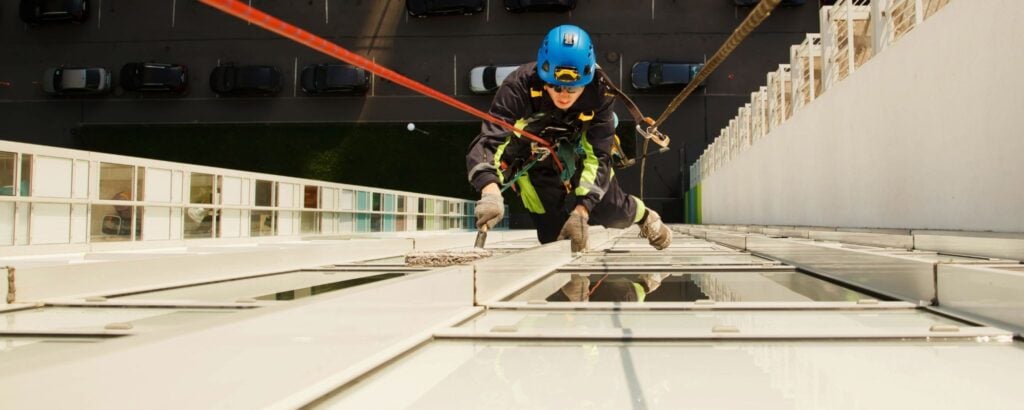
There are practical advantages to formalising building maintenance through a planned contract rather than managing it on a purely reactive basis.
Rope access maintenance contracts are most commonly used for commercial buildings where the external envelope cannot be maintained safely from ground level or through standard access methods. These include:
Buildings with atrium glazing, glass canopies, or complex facade geometries particularly benefit from having an established rope access maintenance relationship, as these elements require specialist access capability that cannot always be quickly sourced on a reactive basis.
When evaluating or commissioning a rope access building maintenance contract, the following elements should be addressed as a minimum:
| Contract Element | Why It Matters |
| Scope of services | Defines what is included: inspection, repair, cleaning, emergency response |
| Inspection frequency | Agreed schedule for planned visits; typically annual or biannual as a minimum |
| Emergency response terms | Agreed attendance times for reactive and emergency callouts |
| Reporting and documentation | Condition reports, defect logs, and completion records for each visit |
| IRATA compliance | Confirmation that all rope access work is carried out to IRATA standards |
| Accreditations and insurance | Contractor holds appropriate accreditations and adequate public liability cover |
| Anchor point and eyebolt testing | Schedule for testing and certifying permanent anchor systems |
| Defect escalation process | Agreed procedure for reporting and acting on defects found during inspection |
GLRE works with building owners, managing agents, and facilities management companies on both planned and reactive maintenance programmes. The starting point for any long-term maintenance relationship is a site survey by an IRATA Level 3 supervisor, which establishes the current condition of the building envelope, identifies the access configuration, and forms the basis for a proposed maintenance scope and schedule.
All rope access works are carried out to IRATA standards, with a Level 3 supervisor present on site throughout. GLRE holds ISO 9001:2015 certification, CHAS Elite accreditation, SafeContractor approval, and Constructionline Platinum membership, providing clients with documented assurance of quality and safety management standards.
The company has provided maintenance and repair services to clients including Barclays, CBRE, Kier, Morgan Sindall, National Grid, Network Rail, the NHS, and Willmott Dixon. Project experience includes work at Alexandra Palace, Center Parcs, Hull Royal Infirmary, and a number of major shopping centres and retail complexes across the UK. Further information on GLRE’s approach to rope access maintenance is available on the GLRE Manchester services page.
The first step is a site survey to assess the building and agree a proposed scope of maintenance works. GLRE offers free site surveys for commercial properties across the UK. To arrange a survey or discuss your building maintenance requirements, visit the GLRE contact page or call the Manchester office on 0161 850 0605.
To discuss a long-term rope access building maintenance contract or book a free site survey, contact the GLRE team today and speak to an IRATA-qualified specialist.



GLRE © All Rights Reserved 2026