Statement leading to lead magnet.

Find out what accreditations to look for, questions to ask, and red flags to avoid when choosing a rope access contractor. GLRE holds IRATA, CHAS Elite and ISO 9001.

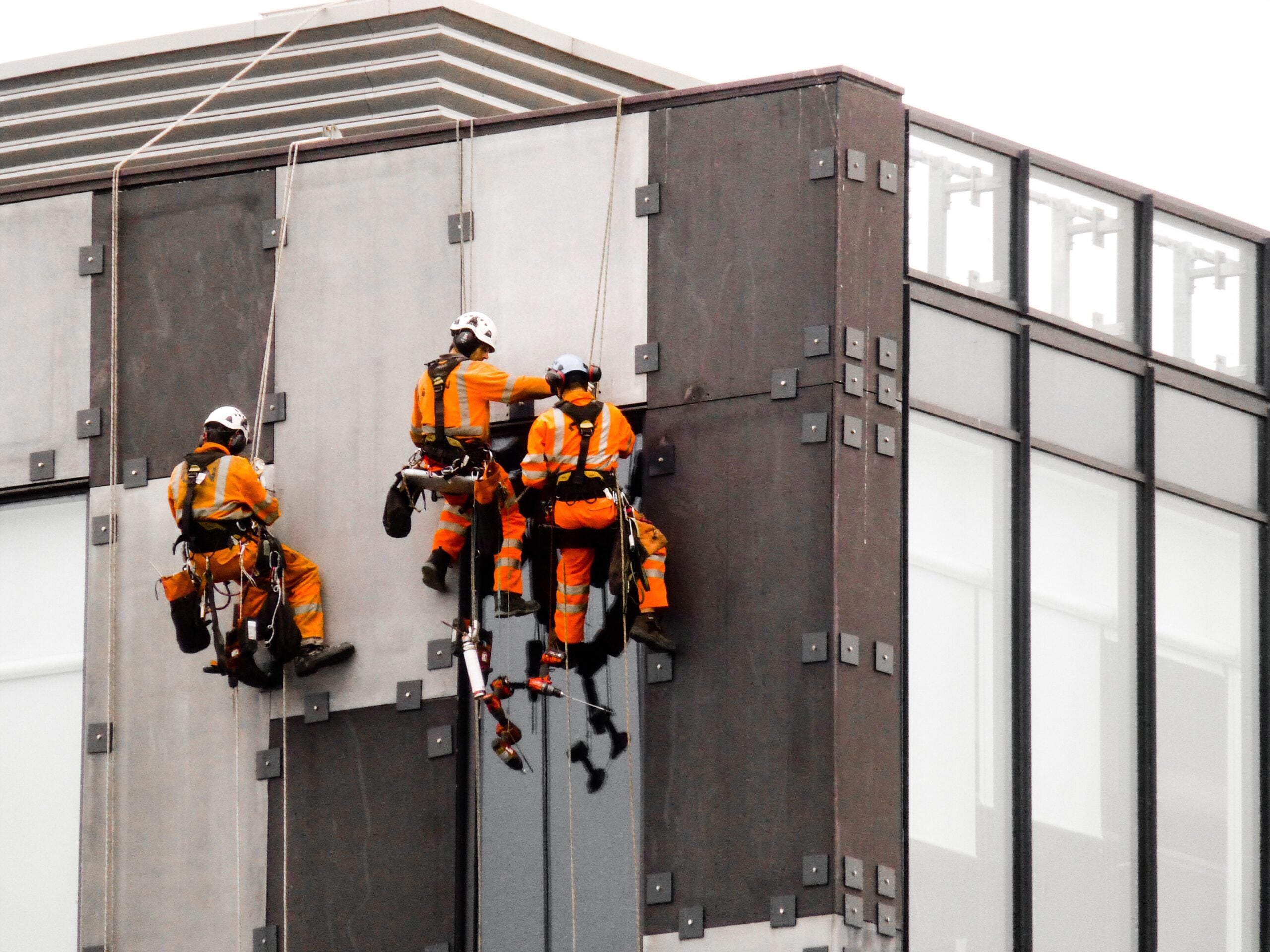
When choosing a rope access contractor for commercial building maintenance or glazing works, the most important factors are IRATA qualification of all operatives, independently verified health and safety accreditations, demonstrable experience with your building type, and a clear, documented approach to risk assessment and method statements. A contractor who cannot provide evidence of all four should not be appointed for work at height on a commercial building.
Rope access work at height carries inherent risk. The safety of operatives, building occupants, and members of the public depends directly on the competence of the contractor appointed. Unlike some forms of building maintenance where substandard work may be inconvenient but not immediately dangerous, poorly managed rope access carries serious consequences if the required standards are not met.
The Work at Height Regulations 2005 place a duty on those who commission work at height — not just those who carry it out — to ensure that it is properly planned, appropriately supervised, and executed safely. This means that building owners, facilities managers, and principal contractors have a legal interest in the competence of any rope access specialist they appoint.
Beyond safety, appointing an appropriately accredited contractor also protects the client in the event of a compliance audit, insurance claim, or dilapidations dispute. Documented evidence of a contractor’s qualifications and method of working can be a material factor in those situations.
The following table sets out the key accreditations to look for when assessing a rope access specialist, what each one confirms, and why it is relevant to your appointment decision.
| Accreditation | What It Is | Why It Matters |
| IRATA membership | International Rope Access Trade Association. The principal industry body for rope access. Operatives are certified at Level 1, 2 or 3. | Confirms technicians have passed independently assessed rope access training. Level 3 supervisors must be present on site. |
| CHAS or SafeContractor | Contractors Health and Safety Assessment Scheme and SafeContractor are independent health and safety pre-qualification schemes. | Confirms the contractor’s H&S management systems have been independently assessed against recognised standards. |
| ISO 9001 | International standard for quality management systems, audited by an accredited certification body. | Demonstrates a documented and independently audited approach to quality control across all operations. |
| Constructionline | Government-owned pre-qualification scheme used extensively by public sector and large commercial clients. | Confirms the contractor meets financial, H&S, and quality thresholds. Platinum is the highest membership tier. |
For public sector clients and those working under a formal procurement framework, Constructionline, CHAS, and SafeContractor registrations are often pre-qualification requirements rather than optional considerations. Verifying that a contractor’s accreditations are current — not simply that they were held at some point in the past — is an important step in the assessment process.
The following questions are worth raising with any rope access contractor before appointment, regardless of the size or nature of the project.
A contractor who is hesitant to answer any of these questions clearly, or who cannot provide documentation to support their answers, should be treated with caution. Established rope access specialists expect to be asked these questions and will have documentation readily available.
The following are warning signs that a rope access company may not meet the standards required for safe, compliant work on a commercial building:
IRATA (Industrial Rope Access Trade Association) is the internationally recognised body that sets the standards for safe rope access practice. It operates a three-level qualification framework, with each level requiring a minimum period of logged hours and an independently assessed practical examination.
The critical point for clients is that IRATA Level 3 qualification is required to supervise rope access works. A Level 3 supervisor designs the rope rig, carries out the site-specific risk assessment, and takes responsibility for the safety of the team throughout the project. Without a qualified Level 3 supervisor on site, a rope access operation does not meet IRATA standards, regardless of the qualifications held by individual technicians.
IRATA publishes its membership directory publicly. Clients commissioning rope access works can verify that a contractor is a current IRATA member and confirm the qualification levels held by named operatives through the IRATA International website.
Our post on how GLRE approaches a rope access site survey explains in practical terms what the Level 3 supervisor’s role looks like from the client’s perspective.
The required qualifications and documentation do not diminish for smaller projects. IRATA standards apply to any use of industrial rope access techniques, regardless of the height involved, the number of operatives, or the duration of the works. A single-day make-safe attendance requires the same Level 3 supervision and risk assessment as a multi-week facade refurbishment.
For projects that fall within the scope of the Construction (Design and Management) Regulations 2015 (CDM 2015), there are additional duties on clients and contractors relating to the appointment of competent duty holders, the preparation of a construction phase plan, and notification to the HSE where notifiable thresholds are met. CDM 2015 applies to most commercial construction and maintenance projects above a defined scale.
If you are unsure whether CDM applies to your project, the HSE’s CDM 2015 guidance provides a useful starting point.
On completion of rope access works, a professional contractor should provide the following documentation as a minimum:
Retaining this documentation is important for building owners and facilities managers, both for ongoing maintenance planning and as evidence of due diligence in the event of a future insurance claim or compliance review. Our health and safety dilapidations report service is available to clients who require a formal condition report produced by a qualified IRATA supervisor.
GLRE’s rope access teams are IRATA-qualified, with Level 3 supervisors present on every project. Our accreditations include CHAS Elite, SafeContractor, ISO 9001:2015, and Platinum Constructionline membership. We carry out a formal site survey before every project, produce a site-specific RAMS for each attendance, and provide photographic records and completion documentation as standard.
We have been providing rope access and glazing services to commercial clients across the UK for nearly 30 years, working on behalf of clients including major property companies, NHS trusts, retail operators, and national infrastructure managers. A selection of completed projects is available on our projects page, and our full accreditation documents are available on request via our about page.
To request accreditation documents, discuss a project, or book a free site survey, contact GLRE today and our team will respond promptly with the information you need.


GLRE © All Rights Reserved 2026