Statement leading to lead magnet.

Industrial rope access has revolutionised how we approach challenges, delivering remarkable savings alongside enhanced operational efficiency.


When facility managers and project directors evaluate access methods for building maintenance, inspections, or specialised construction work, the financial implications can be staggering. Traditional scaffolding, whilst familiar, often presents a significant burden on project budgets and timelines. Industrial rope access has revolutionised how we approach these challenges, delivering remarkable cost savings alongside enhanced operational efficiency.
Traditional scaffolding demands substantial upfront investment that many organisations find difficult to justify. For standard high-rise maintenance projects, scaffolding costs can represent a significant portion of the total project budget for materials alone. When factoring in transportation, assembly labour, and eventual dismantling, these figures climb substantially higher.
The hidden costs often prove even more problematic. Permit requirements, particularly for structures extending into public spaces, can add significantly to project expenses. Insurance premiums increase due to the elevated risk profile associated with scaffold assembly and dismantling phases.

Commercial rope access techniques offer a dramatically different cost structure. Projects that require substantial scaffolding investment can often be accomplished with significantly lower rope access setup costs – representing substantial potential savings.
This cost advantage stems from the minimal infrastructure requirements. Industrial abseiling relies on specialised equipment including ropes, harnesses, and anchor points, but eliminates the need for extensive temporary structures. The primary investment focuses on certified technicians rather than materials and complex installations.
The temporal advantages of rope access techniques extend far beyond simple scheduling convenience. Traditional scaffolding installation requires several days or weeks for complex structures, with significant time needed for assembly, followed by the actual maintenance period, then additional dismantling time.
Rope access teams can commence work within hours of arriving on-site. Building inspection projects that might take well over a week with scaffolding can often be completed in a fraction of the time using industrial rope access methods.
This time compression delivers multiple financial benefits: reduced labour costs, shorter project durations, minimised business disruption, and faster return to normal operations.
The safety credentials of industrial rope access prove exceptional, with industry associations reporting significantly lower accident rates compared to traditional construction methods. This superior safety performance translates into tangible financial advantages through lower insurance premiums, reduced liability exposure, and fewer costly work stoppages.
However, rope access does require investment in specialist training. Professional certification programmes require financial investment per technician, representing an ongoing commitment to maintaining highly skilled teams. This investment pays dividends through enhanced safety outcomes and operational efficiency.
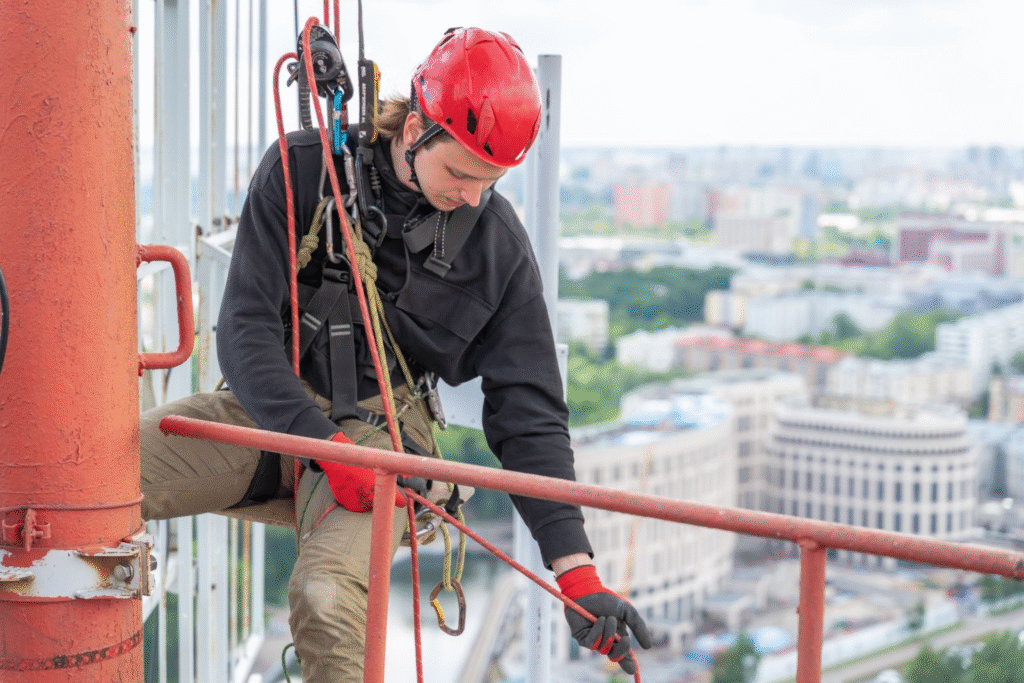
Rope access glazing projects particularly benefit from the technique’s adaptability. Traditional scaffolding struggles with irregular surfaces, architectural overhangs, and obstacles that require expensive custom engineering solutions. Industrial rope access provides elegant solutions for curved surfaces, intricate architectural features, and locations with limited ground space for conventional scaffold foundations.
This flexibility often eliminates the need for costly alternative access methods such as crane hire or specialised platform rentals, which can add substantially to project costs.
Traditional scaffolding often requires extensive permitting, especially when structures extend beyond property boundaries or impact public access. These permits, combined with potential business disruption and pedestrian traffic management, can add substantially to project expenses.
Industrial rope access typically maintains a minimal environmental footprint and rarely requires complex permitting processes. The reduced material requirements align with corporate sustainability goals, eliminating the need to manufacture, transport, and dispose of temporary structures.
The choice between access methods shouldn’t rely solely on initial cost comparisons. Total project cost evaluation must encompass setup expenses, labour requirements, safety considerations, permit fees, and potential business disruption.
Traditional scaffolding remains appropriate for projects requiring extended continuous access over several months, work involving heavy materials requiring stable platforms, or situations where multiple workers need simultaneous access to identical areas.
Commercial rope access proves more cost-effective for short to medium-duration projects, complex geometries, time-sensitive maintenance work, congested urban environments, and environmentally sensitive locations.
The financial analysis overwhelmingly favours industrial rope access for most contemporary industrial applications. The combination of dramatically reduced setup costs, improved time efficiency, and superior safety records creates compelling economic advantages that forward-thinking organisations increasingly recognise.
As rope access technology continues maturing and more technicians achieve certification, these advantages will become even more pronounced. Smart project managers understand that industrial rope access represents not merely an alternative to traditional methods, but often the optimal solution for modern access challenges.
The evolution towards rope access techniques reflects broader industry trends emphasising efficiency, safety, and cost-effectiveness – making it an investment in both immediate project success and long-term operational excellence.
Don’t let traditional access methods drain your budget and extend your timelines. Our certified IRATA technicians are ready to demonstrate how industrial rope access can deliver the cost savings, safety improvements, and operational efficiency your project demands. Contact us now.



GLRE © All Rights Reserved 2026